We won the World cup...
I believe we are ahead in the scale of progress.
So does not that prove that caste and creed and land of birth, how rich or poor, does not matter..?
What matters really is the unity of the country, and the common goal...
Let me prove the point in question.
1) The bowling is led by 2 young muslims
2) The coach is a devout christian
3)The captain is a rags to riches story. He dared to dream and made it against odds because he believed.
4) The star player comes from Chandigad
5) The icon player is a Saraswat Brahmin
6)The top spinner is a Sikh from Jalandhar
7)One of the finest batsman is from Ghaziabad
8)Another is a jat from Hariana
9)Another is a kashmiri Pandit
10)The third bowler comes from Kothamangalam in Kerala
11) Another bowler comes from Aligarh
( Above information from 'The Power of Inclusivity' by Pritish Nandy
We deserved to win! We have come a very long way...Keep going India
We are with you
Lekin yeh soch banaaye rakhna
I know there is fundamentalism trying to rear its ugly head, but I believe that those who spread hatred could be politicians but not true spiritualists!
Wednesday, April 06, 2011


Sunday, April 03, 2011
Festivals galore
4th of April
Navratras
Click:
http://www.dalsabzi.com/Language_Festivals/navratra.htm
5th of April
Sindhi New Year
Jhulelal
http://www.dalsabzi.com/Language_Festivals/jhulelal.htm
4h of April
Gudi Padwa:
http://www.dalsabzi.com/Language_Festivals/GudiPadwa.htm
It is ausicious to read the Ramayana during Navratras,
Read it in short
Read the Ramayana
http://www.dalsabzi.com/books/symbolisms_ramayana/intro.htm
Friday, March 25, 2011

Happy Birthday to His Holiness Dr Syedna Mohammed Burhanuddin Saheb (T.U.S.)
We have members of the Bohra community living in our building. They generally 'keep to themselves' and are peaceful neighbours and occassionally flash a smile as we meet in the lift.
A few years ago there was a lot of commotion and festivilty fervour in our foyer. I asked what we were celebrating. They mentioned that the Syedna was visiting a resident of/in our building.
There were many awaiting to welcome His Holiness.
I have always travelled miles to be in the aura of Spiritual personalities...so I asked myself: "Why lose this opportunity"?
I covered my head and stood with the ladies, but obviously I stood out and the Syedna invited me into the car and acknowledged my feeling.
Everyone present and those who saw the interaction said I was very lucky and I felt so.
Today as I see the whole newspaper filled with articles of His Holiness and multitudes wishing him well, I feel more blessed.
Wednesday, March 23, 2011
Chapter 5 Lesson 5
According to Vedanta we are Divine beings having a human experience and not human beings (occasionally) having a divine experience.
So why do we not ‘see’ or ‘recognize’ our divine nature?
Because it is covered by Kaam (passion) krodh (anger) lobh (greed) moha (attachment) and ahankaar (ego) These 5 form a dark film over our clear ‘glass’
This ‘clear glas’ is equivalent to the ‘divine’ in everything and everyone.
You may have heard the lovely couplet:
Ghoongat ke pat khol re
Tohey piya milenge
Which means:
Move aside your veil
And you will meet your beloved
And now maybe one will be able to understand better:
Where knowledge exists, Ignorance can not.
So when one removes Ignorance, one does not create knowledge…One rediscovers it!
and
The point that Krishna makes:
‘Knowledge is being enveloped by ignorance, thereby beings are constantly falling a prey to delusion’
If you would like to read what I have written so far, Click:
http://www.dalsabzi.com/wisdom_script/bhagvad_gita.htm
Friday, March 18, 2011
Today is Holi
Tomorrow we colour one another with love and friendship
Read about festival and legends connected with it.
Click:
http://www.dalsabzi.com/Language_Festivals/holi.htm http://www.dalsabzi.com/Books/kids_kahaani/bhaagvad_stories/prahlad_and_holika.htm
Tomorrow we colour one another with love and friendship
Read about festival and legends connected with it.
Click:
http://www.dalsabzi.com/Language_Festivals/holi.htm http://www.dalsabzi.com/Books/kids_kahaani/bhaagvad_stories/prahlad_and_holika.htm
Tuesday, March 15, 2011

On March the 13th 2011 was invited to a book release function of 'Women in Hindu Society ( A critical Appraisal of their status in India from the Vedic Period to Modern Times) The book is authored by Shri S.K. Kulkarni and was released at the hands of Ms Supriya Sule (Member of Parliament.
My gracious hostess was Ms Sonavi Desai who facilitates these inspiring books through Indus Source Books.
Some very interesting points were made by Shri Ujjwal D Nikam, Shri Satish Sahney, Dr Vibhuti Patel and Smt Arundati Hoskeri.
My comments: We may have taken certain steps on the 'rightful status of women' but there is yet a lot of terrain to be crossed...Door nagri badi door nagri...
The book is worth a dekho. Look it up
...and thanks Sonavi. Keep up the good work!
For more information, click:
www.indussource.com
Saturday, March 12, 2011
15th Verse of the 5th Chapter
My note:
Allow me to warn you that it is verses like the ‘following’ that confuse Readers of the Geeta and so put the Grand Book aside.
Krishna says that:
‘The omnipresent God does not take merit or demerit of any’
My note:
I myself believe that it is the Karma Theory that is in operation and that God does not peep down from clouds and keep account of very sin and merit of people around the world…
Don’t forget that according to Vedanta the ‘Finite World’ is an illusion.
The other point that Krishna makes in the above verse is:
‘Knowledge is being enveloped by ignorance, thereby beings are constantly falling a prey to delusion’
My note:
Where knowledge exists, Ignorance can not.
So when one removes Ignorance, one does not create knowledge…One rediscovers it!
If you would like to read what I have written so far, Click:
http://www.dalsabzi.com/wisdom_script/bhagvad_gita.htm
My note:
Allow me to warn you that it is verses like the ‘following’ that confuse Readers of the Geeta and so put the Grand Book aside.
Krishna says that:
‘The omnipresent God does not take merit or demerit of any’
My note:
I myself believe that it is the Karma Theory that is in operation and that God does not peep down from clouds and keep account of very sin and merit of people around the world…
Don’t forget that according to Vedanta the ‘Finite World’ is an illusion.
The other point that Krishna makes in the above verse is:
‘Knowledge is being enveloped by ignorance, thereby beings are constantly falling a prey to delusion’
My note:
Where knowledge exists, Ignorance can not.
So when one removes Ignorance, one does not create knowledge…One rediscovers it!
If you would like to read what I have written so far, Click:
http://www.dalsabzi.com/wisdom_script/bhagvad_gita.htm
Tuesday, March 08, 2011
Happy Women's Day
Do read my book 'Power of Feminine'
It is on my website for free persusal.
Click:
http://dalsabzi.com/the_power_of_the_feminine.pdf
Do please fwd the link.
Thanks and luv to all you wonderful women out there!
Shakun Narain
Do read my book 'Power of Feminine'
It is on my website for free persusal.
Click:
http://dalsabzi.com/the_power_of_the_feminine.pdf
Do please fwd the link.
Thanks and luv to all you wonderful women out there!
Shakun Narain
Sunday, March 06, 2011
Chapter 5 Lesson 4
My note:
Do you know why the Lotus Flower is the National flower of India?
The Lotus symbolizes divinity, knowledge and enlightenment.
Why does it symbolize the above?
Because despite the fact that the lotus is born and grows in mud, it is untouched by it!
That is the way a truly Spiritual man must live in this world.
Though living midst negativity, he remains clean.
The Lotus flower therefore also symbolizes purity of heart and mind.
It is for the above reason that the lotus is ‘held’ by many Gods and Goddesses and is often used in religious practices.
Lord Krishna in the 10th Verse of Chapter 5, states:
He who acts offering all actions to God, and shaking off attachment, remains untouched by sin, as the lotus leaf by water.
If you would like to read what I have written so far, Click:
http://www.dalsabzi.com/wisdom_script/bhagvad_gita.htm
Saturday, March 05, 2011
Have compiled some notes on:
DEPRESSION
It is NORMAL to be depressed sometimes
It is abnormal to be depressed all the time
SOME SYMPTOMS
Loss of interest or concentration
Suicidal thoughts
Excessive fatigue
Early morning wakefulness
Difficulty in functioning socially
Slowed down or speeded up thinking or activity
MENTAL HEALTH
Talks too much or too little
Stops communicating
Sometimes violent
Generally out of touch with reality
ONLY YOU CAN HELP YOURSELF
EXERCISE
It produces chemical and psychological changes that improve your mental health
It gives you a feeling of accomplishment and mastery
Changes levels of hormones
Elevates your beta endorphins (mood affecting brain chemicals)
NUTRITION
Vitamins and foods rich in Vitamin B
Green vegetables, fish, eggs
SOCIALIZE
Discuss your deep down feelings with people who can empathize with you
You might think people ignore you…think your way out…maybe he id not see you or was pre-occupied
If you are feeling unattractive, get a new hairstyle
If not succeeding at a job, take a course to improve skill
Plan activities that give you a sense of accomplishment
Go to concert, club, meeting or clean out cupboard
Keep friends with whom you can share joys, fun, complaints
CHECK YOUR THYROID
Depression could be due to hormonal imbalance
LOW SUGAR CAN MAKE YOU FEEL LOW
CHECK MEDICATION YOUR ARE TAKING
UPLIFTERS
1) This too shall pass
2) Life is a dream
3) Let go and Let God
4) Things could be worse and you would be as helpless
5) Do your best and Leave the rest
6) It is God’s Will
7) Music
8) Exercise
9) Drink water
10) Pick up a
11) Sutra
12) Ishta
13) Mantra
14) Sant
15) Grantha
Wednesday, March 02, 2011
Today, the 2nd of March is Maha Shivratri.
I have compiled a lot of interesting information.
Pls click:
http://www.dalsabzi.com/Language_Festivals/shivratri.htm
I have compiled a lot of interesting information.
Pls click:
http://www.dalsabzi.com/Language_Festivals/shivratri.htm
Sunday, February 27, 2011
Chapter 5 Lesson 3
Not the Doer
My note:
Before I go on to what Krishna says in the Geeta next, we need to understand another Hindu concept.
The above concept claims that one is not really the doer!
Please do not smirk and dismiss. Read on!
The Vedanta concept claims that the real 'I' is not the doer, it is the 'Witness'.
In Indian parlance, Witness is the ‘Saakshi’.
Difficult to understand, no?
Lord Krishna says in Verse 6 of Chapter 5, that (not only is the above concept difficult to understand but also) it is difficult to accomplish.
Krishna says that he who knows the reality of things, must believe, even though seeing, hearing, smelling, eating or drinking, speaking, answering the calls of nature, grasping and opening or closing the eyes, that he does nothing, holding that it is the senses that are moving among their objects.
Krishna urges that one must keep ones mind fixed in God, master ones mind, identify oneself with (ones)true self, offers all ones actions to God, shake off attachment, reaches Brahma (God) in no time as one remains untainted even though performing action.
If you would like to read what I have written so far, Click:
http://www.dalsabzi.com/wisdom_script/bhagvad_gita.htm
Tuesday, February 22, 2011
Chapter 5 Lesson 2
My note:
Why does Krishna say that the Yoga of Action is superior to that of Renunciation (Though both roads lead to ‘Highest Bliss?)
To my mind, Renouncing, in the true sense of the word is indeed difficult. If one has a ‘troubled mind’ that mind will pursue one wherever one may be.
Also one cannot really ‘be without action’ and possessions.
Even a renunciate has to act in the form of begging for alms or cooking to eat and sustain himself.
One may argue that those actions do not accrue karmas and one is probably right. But what does one do with a troubled mind that finds myriads of ways to react?
Just for interest sake. I have heard that sanyasins can get attached to the 2nd set of clothes (worrying that they may be stolen) and hence own only one pair, which is washed simultaneously as one bathes.
Out of the millions who took to the woods to search for ultimate union with the Lord, a handful made it. But then so many who stayed in the ‘market place’ also did!
Sincerity is the key.
Meera says: Bhav saagar sab sookh gayo hai, fikr naheen mohe tarnan ki…
Which means, the Ocean (world) has dried up for me, I am not worried about remaining afloat…But then why did Meera leave home? Because for her, the palace held no allure and she wanted to be left in peace to sing to and for her Lord!
If you would like to read what I have written so far, Click:
http://www.dalsabzi.com/wisdom_script/bhagvad_gita.htm
Sunday, February 20, 2011
CHAPTER 5
Lesson 1
Despite Krishna’s early instructions. Arjuna is confused.
Dear Readers, remember I had told you that the questions that would arise in you will also arise within Arjuna?
Arjuna asks Krishna: Which is superior? The Yoga of Action or the Yoga of renunciation of Action (to retire to a jungle,to live in constant inactivity, a life of self denial)?
Lord Krishna answers: Renunciation of action and Yoga of action both lead to the “Highest bliss’ but of the two the Yoga of Action is superior to the Renunciation of Action.
He should be known as a perpetual sanyaasi (renunciate) who neither hates nor desires,(even though he lives in the market place of the world) for free from pairs of opposites (love hate, joy sorrow…) he is easily free from bondage”
If you would like to read what I have written so far, Click:
http://www.dalsabzi.com/wisdom_script/bhagvad_gita.htm
Saturday, February 19, 2011

Was invited to a conference of neuro surgeons hosted by the 16th convention of Academia Eurasiana Neurochirurgica inauguration
Had the honour of doing darshan of the Dalai Lama at the Taj, Crystal Room. His Holiness said that the Science of the mind can be seen in the ancient Indian traditions of samadhi and vipassana. Technology coupled with peace is the key to progress. Keep the mind calm but go to doctors for cure.
The wonderful event was organized by Dr Keki Turel.
Tuesday, February 15, 2011
Chapter 4 Lesson 10
In the previous verse we learned that through knowledge, Truth, God realization and peace is attained.
Knowledge is attained through the company and teachings of Illumined Souls.
What happens to those who are possessed by doubt?
He is lost in the Spiritual path and there is no happiness for him in this world nor in the world beyond. Therefore O Arjuna, Krishna says, slash to pieces this doubt in your heart, with the sword of wisdom, and stand up for the fight.
My note:
One is able to live in a reasonably sane manner in the world, because of ones faith, that one will not die of a heart attack, or the building will not crumble down on us or we shall not die as we cross the road…The more faith one has the more one is able to accomplish…
So much for faith…
When Krishna says ‘stand up for the fight’ one may interpret it as ‘face life with courage!’
And thus ends the Chapter 4 of the Bhagvad Geeta.
If you would like to read what I have written so far, Click:
http://www.dalsabzi.com/wisdom_script/bhagvad_gita.htm
Friday, February 11, 2011
Knowledge (Gyaan)
Chapter 4 Lesson 9
Lord Krishna in Chapter 4 Verse 39 states that One who has mastered his senses and is full of faith, attains to knowledge (Gyaan)
Through knowledge, the truth is revealed to him and in the state of God realization, he attains peace.
Lord Krishna describes knowledge as a great purifier.
Sacrifice (Action) through knowledge is superior to sacrifice performed with material things.
Just like the blazing fire turns fuel into ashes, so the fire of knowledge turns all actions to ashes.
(So why renounce actions? Use knowledge or the power to discriminate…and apne karam karte chalo and dharam nibhaate chalo)’.
Krishna says that knowledge alone would carry you, even though you were the foulest of sinners, like a raft across all your sin.
But how to attain that knowledge?
Lord Krishna in Verse 34 states that if one prostrates at the feet of Illumined Souls, render them service, question them with an open and guileless heart, those wise seers of Truth will instruct one in that knowledge.
If you would like to read what I have written so far, Click:
http://www.dalsabzi.com/wisdom_script/bhagvad_gita.htm
Sunday, February 06, 2011
Chapter 4 Lesson 8
My note:
It has been explained earlier that ‘sacrifice’ implies a ‘prayer’, an action, which could mean ‘an offering’ It has also been explained that if you would like to become a doctor, your ‘sacrifice’ or ‘action’ would be ‘your relevant study to become a doctor’.
In that context Krishna explains that ‘sacrifice’ can imply:
1) Seeing Brahma (God everywhere and in everyone)
2) Sacrifice of senses into the fire of self discipline.
3) Functions of the senses into the fire of yoga in the shape of self control, kindled by wisdom.
4) Sacrifice of material possessions, austerities, practice of Yoga, study of sacred texts, and practice of breath control.
Krishna states: “To the man who does not offer sacrifice, even this world is not happy; how then can the other world be happy?
If you would like to read what I have written so far, Click:
http://www.dalsabzi.com/wisdom_script/bhagvad_gita.htm
Sunday, January 30, 2011
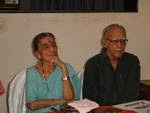
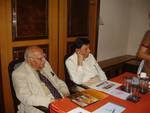


Mr Ram Jethmalani is a well known face amongst the legal community in India. Even though he is primarily known as only a criminal lawyer, he has appeared in many high profile cases.
I have known him nearly all my life as his daughter Shobha was a school class mate of mine and we continue to be good friends.
Ms Asha Chand,has a tremendous passion: To promote the Sindhi Language
Yesterday, the 29th of January I attended a meeting where we requested Mr Jethmalani to pursue our demand of a 24 hour Sindhi TV Channel from the Govt of India.
At the time of Partition we Sindhis did not receive any land to call our own, and yet in 60 years we Sindhis have struggled, not only survived but given back to Society in terms of Hospitals, Education Institutions...So in my mind we Sindhis deserve that much! What? A DD Sindhi 24 hour channel!
High quality TV Production could be the first step which can open more avenues of learning ones beautiful culture and language over a period of time!
I endorse what Asha Chand said:
We have three Mothers:
1) Who gave us birth
2) Matru Bhoomi (Our land)
3) Our Language
Do I even need to say that we must nurture them?
How?
Even putting a signature to a signature campaign might help. not to talk about sponsoring programmes on tv or speaking with personalities who may be able to help in the endeavour, or forwarding this note or blog url...
To watch a TV Interview that Asha Chand did of 'Yours Truly, Click on:
www.dalsabzi.com
For more Info
E Mail: info@sindhisangat.comwww.sindhisangat.com
www.sindhisangat.tv
Wednesday, January 26, 2011
I was really touched by what this gentleman wrote to me after reading my article.
Click:
http://www.dalsabzi.com/books/sindhi_surnames/sindhis_and_sindhi.htm
Feedback for: Welcome to Dal Sabzi for Aatman : Sindhis and Sindhi
Name : SHAHID
Comment :
I m a SINDHI man and m living in Hyderabad, SINDH. I have just read this article and felt extremely sorry for the attitude of those TWO Sindhi guys that sister Shakun Narain Kimatrai mentioned. Sister Shakun, ur love for ur ancestors and their language is beyond any doubt. Sister, when i read ur article i have moved in my heart alot. U r quite right that you all Hindus left ur land with heavy heart.Today, I m 35 yrs old but when i see old builings of hindus in areas like Hearabad, Gaari Khataa, Market Tower and Station Road, i m compelled to think that how beautiful structures are these, and the owners of these structure had certainly abandoned all these with the heavy rain of tears in their eyes. O God, would this never happened. This is a deadly and very painful feeling of deprivation of their priceless assests. Sister, i do apologise on behalf of those TWO sindhi guys who hurt u rather than realising ur position and environment in which u r living ; and that whatever happened some sixty three years ago was absolutely wrong.
URL : http://www.dalsabzi.com/books/sindhi_surnames/sindhis_and_sindhi.htm
Chapter 4 Lesson 7
Rag Dvesh Likes Dislikes
My note:
Hindu Philosophy constantly speaks about going beyond the ‘Pairs of opposites’
What are these pairs of opposites?
Joy, Grief…Success failure…Likes dislikes…
How does one ‘go beyond’ these pairs?
By going through them as one goes through summer winter, heat cold, day night…
How does one do that?
Wear a sweater, put on a heater, light a fire during winter…and wear light clothes, have a dip in water, switch on a fan or air conditioner during summer…In other words do your best to insulate yourself and get on with the act of living…
Keep away from a burning fire or storm the best way you can.
Keeping on complaining does not really benefit you or others, is it not so?
Krishna states in Verse 20, 21, 22, 23 of Chapter 4:
He who gives up attachment to fruit…performs only bodily action…Is content with whatever is got unsought…transcends all pairs of opposites…Is established in the knowledge of the Self…is not bound by his action… and incurs no sin.
If you would like to read what I have written so far, Click:
http://www.dalsabzi.com/wisdom_script/bhagvad_gita.htm
Friday, January 21, 2011
Chapter 4 Lesson 6
Action Inaction
Karma Akarma Vikarma
My note:
In the 16th Verse of Chapter 4 Krishna explains action, bad action and inaction or Karma, Vikarma and Akarma.
My note:
Karma is an action pure and simple but what is Akarma or Non Action or Vikarma a bad action?
Let us try and understand it through an example: An evil person is urgently looking for another person who he wants to harm. You know in which direction the persecuted person went. When the evil one asks you if you saw where he went, you did not reply …or lied?
Is it a Vikarma, a bad action? An akarma, a non action? Or a karma?
Let us take another example. A man deserts his wife and children because he does not want to make more karmas as he believes that is the way to liberation?
Is it a Vikarma, a bad action? An akarma, a non action? Or a karma?
Krishna states in Verse 17 that mysterious are the ways of action. In Verse 18 Krishna states: He who sees Inaction in Action and Action in Inaction is wise among men; he is a Yogi.
In Verse 20 Krishna states: He who gives up attachment to fruits of action and does nothing at all (is a man of inaction) though fully engaged in action.
If you would like to read what I have written so far, Click:
http://www.dalsabzi.com/wisdom_script/bhagvad_gita.htm
Sunday, January 16, 2011

Sri Morari Bapu is in Mumbai. I used to go to his kathas and enjoy every moment of it. I was able to sit for 3 hours at a stretch. I wrote 'In touch with Masters' 'Symbolisms in the Ramayana' translated 'Nisaadhanta' got written Aashirwaad' (all up on my website: www.dalsabzi.com )
I feel completely blessed and fulfilled.
Yesterday attended a Bharatiya Vidya Bhavan, Guru Gangeshwarananda Veda-Ratna Puraskaar where I was able to meet Bapu. I feel it was a gift from above!
Thankyou!
Shall let you in to a Vision. Well not sure if it was a vision, but in any case it was different from a dream or imagination.
I 'saw' that 'Masters' were getting ready for a journey...I believe it was to incarnate. I see myself as about 8 years old, yearning to take the trip with them.
But I feel I am not ready yet. The Masters say "Come along" We shall help you along the way! I believe the Masters are those I have written about in "In touch with Masters"
I asked my Guru Ma Indira Devi, if the vision was right. She replied with a mischievous smile: "Whether true or not, most people think that they have come to 'help' At least you believe that you have come to be helped...and that is good :)"
Saturday, January 15, 2011
Just like the elements move towards their source.
Water moves towards the Ocean, downwards...
Fire move towards the Sun, upwards (Even when you hold a match down the flame will go up...
So do humans move towards love, Must be because that is their source...
I was reading: The heart's capacity to hate is limited unlike that 'to love' Love gives one joy, power and victory and hate brings in sorrow and powerlessness and defeat.
Wednesday, January 12, 2011
Chapter 4 Lesson 5
In Verse 13, Krishna speaks about the 4 orders of Society ie the much criticized caste system.
My note:
Hindu Scriptures speak of the four castes, which is nothing but four types of professions.
Let me tell you about them.
The first is Brahmin. The Learned, professors, priests…
The Second is the Kshatriyas: The warriors, soldiers, protectors…
The third is the Vaishyas: the Commercial community, shop keepers, traders…
The fourth is the Shudras: The working community, those who serve the first three…
In ancient India, the above were considered professions, and one could change them at will. Thus, if one was born into the business community, no one could stop him from becoming a teacher or washing dishes in a restaurant.
As time passed, the learned class started to feel very arrogant and believed themselves to be the’ highest’, because they were the most learned, and knew the Scriptures.
They imposed the ‘law’ that if one was born into one caste, they would remain there for life.
And so the menial workers were referred to as ‘low’ and later ‘untouchable’
If the so called ‘low castes’ had been taught Sanskrit, and to read and write it, they would have known that God did not recognize such a terrible ‘law’
I am going to tell you the story of Shabri.
Shabri belonged to the ‘low caste’
No one befriended her.
So she lived alone.
Her Guru had told her, that Sri Ram would one day visit her cottage.
Shabri would decorate her cottage with beautiful flowers every day, hoping that that would be the wonderful day, that Sri Ram would visit her.
One day Shri Ram arrived at her village, as he traveled, far and wide, in his search for Sita.
And He did visit Shabri’s cottage.
Shabri was beside herself with joy.
She made him sit and brought a plate of berries for him to eat.
She wanted to make sure that they were sweet. It is popularly believed that she tasted the berries before giving them to Sri Ram to eat.
Sri Ram ate them with great relish and was happy at the faith and love that Shabri possessed.
The people in the village were appalled at Shabri’s audacity, but could say nothing to Sri Ram.
They requested Sri Ram to restore the water that had dried up in the well of the village.
Sri Ram said that, that would happen if Shabri bathed in the water of the well, first.
Shabri did. And fresh water returned to the dry well!
If you would like to read what I have written so far, Click:
http://www.dalsabzi.com/wisdom_script/bhagvad_gita.htm
Wednesday, January 05, 2011
Chapter 4 Lesson 4
In Chapter 4 Verse 12 Krishna says: They who long for satisfaction from actions in this world, make sacrifices to the gods…
Let us understand the term ‘gods’ in the context of the Geeta.
We have already learned that a
Yajna could mean any social, communal, national or personal activity into which the individual is ready to pour himself forth entirely in a spirit of service and dedication…
‘Yajna’ is stated as a sacrifice to the gods.
In another verse Krishna claims that those who worship the gods, go to the gods and those who worship Him come to Him.
Easy enough to understand I think!
My note:
You will be surprised to note that Spiritual parlance speaks of Vidya and Avidya.
Vidya is the ‘knowledge and activities that takes one towards God.
Avidya (Please note, the opposite of Vidya is not moorkhta or ignorance) is the knowledge that one requires to survive in the world.
Father John Philipose says: Water fills everything it enters just as God fills those who are immersed in Him".
According to Islamic teachings, water is one of the divine bounties and is referred to in the Quran 63 times. As rain water is a symbol of divine spiritual inspiration.
Water is intrinsically linked to baptism.
The Sikh Khalsa Amrit chakhna ceremony involves drinking of sugar water stirred with a dagger...
Excerpts from an article by Ranjeni A Singh
I do believe that a dip in the Ganga with faith cleanses one of all sins.
Sunday, January 02, 2011
I had read a strange story. A man wears tight shoes and complains every day, whole day, because they pinch him.
Finally friends told him: Why dont you just buy a size bigger?
He answered: Because I love the joy and relief I experience when I remove my very tight shoes!
Bet you did not understand the moral.
Let me explain it to you in Osho's words: Problems don't exist, only people exist, but we create problems out of a certain neurosis because we are afraid to be left alone...When you create a problem you forget the whole world because you are focussed on the problem...You are bigger than the problem and you feel very good, because you know that something can be done about it. You feel very powerful because you can go on playing with it...When you stop the cycle of creating and solving problems, you will become available to the infinite energy that surrounds you.
What to do about problems which are real? I believe in doing what the Geeta says, which I repeat in my own simple words: Do your best and leave the rest or
Let go of your expectations and fixed ideas about how things should be done. Don't try to force things to happen. Just do as much as you can, then step back and see what takes shape.
Friday, December 31, 2010
Thought on The New Year
Thought One
Every New Year, there is one thing that most of us will indulge in, ie making new resolutions.
But do they work? And if they do, for how long? I would like to share with you something that I read in 'Awaken the Giant within' by Anthony Robbins that seems to make sense.
Associate pain with a habit that you are desperately trying to break... I remember, my son, when he was younger would offer his friends a chocolate with the quip "Have a pimple!"
If you hit a level of pain that you aren't willing to settle for anymore you change your old habits or way of living. You could get fed up when you cannot fit into your clothes, or when you cannot bear another hangover, or the sight of the pained look of your wife when you have lost your last penny at the gambling table...finally you say, ' I have had it ' and you make a decision.
Charles M. Sheldon states: Good resolutions are like babies crying in church. They should be carried out immediately.
It is the desire to remove pain from your life and establish the pleasure of self esteem.
May all your dreams come true this coming year. May we have the strength to kick our old debilitating habits and may we all experience tremendous pleasure at the idea of adopting a new empowering Life.
Have a great year!
Another fresh new year is here
Another year to live
To banish worry, doubt and fear,
To love and laugh and give!
This bright New Year is given me,
To live each day with zest,
To daily grow and try to be,
my highest and my best!
I have the opportunity
Once more to right some wrongs,
to pray for peace to plant a tree,
and sing more joyful songs
William A Ward
Thursday, December 30, 2010
Chapter 4 Lesson 2
We learned in the last lesson that Krishna states that He is born from age to age to protect the virtuous and take him (man) to the Supreme. And the latter happens when righteousness is on the decline and unrighteousness is on the ascent.
In Verse 6 of Chapter 4 Krishna states: Though I am unborn and of imperishable nature…yet I take birth by my own Maya.
My note: What does the above mean? It means that the Lord, keeping his Maya perfectly under His control, He comes into the world through His own free will.
The Lord is NOT compelled, like the rest of us , by our karma to take birth after birth under the Laws of Nature.
In Verse 9, Krishna makes a wonderful statement: Krishna states that those who understand the Lord in true light, is not subjected to rebirth but attains the Supreme State. In Krishna’s own words: “He comes to Me, O Arjuna!
Tuesday, December 28, 2010
For years my ma thought I was born on 4th Jan. At the age of 50 I decided I needed to know my real birthdate so consulted an astrologer. My horoscope said 26 dec but astrologer said I could not have been born on the 26th. It seems I was born on 27th early morn when the sun was not out yet. Decided to celebrate my birthday on the 26th as the horoscope said. Hv noticed that 27th is always a hard day to get thru so perforce devote it to prayer. Thanx for all ur blessings. 26 th was good. 27th was difficult. Husband was not really well and kids out of town, so I had to spend my day gvg medicines, praying and learning to 'surrender ' wonder what the lesson is? Why I cannot have a peaceful day on the 27th?
Was reading that looking back at our life experiences, we will find that our lives are easier, more livable because of the difficulties and trials we overcame and the spiritual strength that we gained!
Was reading that looking back at our life experiences, we will find that our lives are easier, more livable because of the difficulties and trials we overcame and the spiritual strength that we gained!
Monday, December 27, 2010
CHAPER 4
In the Chapter 3 Krishna propounded the concept of Karma Yoga.
In Chapter 4 Krishna talks about the fact that man re-incarnates.
Krishna declares that the Lord is born from age to age to protect the virtuous and take him (man) to the Supreme. And the latter happens when righteousness is on the decline and unrighteousness is on the ascent.
Krishna says: I taught this immortal Yoga (what Krishna has been teaching so far to Arjuna) to Vivasvaan (Sun God). Vivasvaan conveyed it to Manu (His son) and Manu imparted it to his son Isvaaku.
Arjuna argues that since Krishna is in the present and Vivasvaan is of ancient origin, how is Arjuna to believe that Krishna taught this Yoga at the beginning of Creation?
Krishna replies: “ Arjuna, you and I have passed through many births, I remember them all, you do not remember.
To read what I have written so far, click:
http://www.dalsabzi.com/wisdom_script/bhagvad_gita.htm
Wednesday, December 22, 2010
This
Xmas,
I would
like to put
up a tree in my
heart, and instead
of hanging presents,
I would like to put the
names of all my friends.
Close friends and not so close
friends. The old friends the new
friends. Those that I see every day
and the ones that I rarely see. The ones
that I always remember and the ones that
I sometimes forget. The ones that are always
there and the ones that seldom are. The friends of
difficult times and the ones of happy times. Friends
who, without meaning to, I have hurt, or, without meaning
to have hurt me. Those that I know well and those I only know
by name. Those that owe me little and those that I owe so much.
My humble friends and my important friends. The names of all those
that have passed through my life no matter how fleetingly. A tree with
very deep roots and very long
and strong branches so that
their names may never be
plucked from my heart. So
that new names from all
over may join the existing ones. A tree with a very
pleasant shade so that our friendship may take a
moment of rest from the battles of life. May the
happy moments of Xmas brighten every day of
the new year. These are my sincere wishes for all of you
Love
Shakun Narain Kimatrai and family
Monday, December 20, 2010
Chapter 3 Lesson 15
In the last lesson Krishna taught us that the seat of desires is the senses.
Now Krishna states: if you control your senses, you will be able to win over 'desires' which is the destroyer of knowledge and wisdom.
In verse 42 Krishna states:
1) Senses are superior to the body
2) Mind is superior to the senses
3) intellect is superior to the mind
4) Aatman is superior to the intellect.
My note:
Through meditation and deep awareness we break our false identifications and discover our divine nature. Then we continue to play the game, but without being attached to results.
I am reminded of a song:
Ab saunp diya is jee van ka sab bhaar tumhaare heathon mein
Hai jeet tumhaare heathon mein aur haar tumhaare haathon mien
And thus ends the third discourse.
To read what I have written so far, click:
http://www.dalsabzi.com/wisdom_script/bhagvad_gita.htm
Thursday, December 16, 2010
Geeta Jayanti
The 17th of December 2010 is Geeta Jayanti
Geeta Jayanti is the anniversary of the day, when the Divine Song (Bhagavad Geeta) was sung.
On this day Shri Krishna spoke to Arjuna, on the battlefield in Kurukshetra.
The Bhagvad Geeta was transcribed into words by Veda Vyasji.
I have read: "The one who takes a dip in the Ganges is liberated. The one who lives according to the Gita can liberate others."
Krishna tells Arjuna in the Bhagavad Geeta Ch 18 Verse 68,69:
Those who teach this supreme mystery of the Geeta to all who love me perform the greatest act of love; they will come to me without a doubt. No one can render me more devoted service; no one on earth can be more dear to me".
The Gita consists of 700 shlokas (verses)divided into 18 chapters
The teachings of the Gita do not apply only to inner and outer conflicts in the battlefield, but to the combat zone (of good and evil) that lives within us.
One is not required to be a Hindu, highly spiritual or extremely intelligent to understand and follow Lord Krishna’s teachings.
Lord Krishna does not advocate only one path in the Bhagvad Geeta.
In fact throughout the Divine Scripture, Krishna explains how one can attain liberation depending upon the inclination of different temperaments of man.
One may unite with God through devotion (Bhakti), through wisdom (Gyaan), and through action (Karma) -
Mahatma Gandhi said, "When disappointment stares me in the face and all alone I see not one ray of light, I go back to the Bhagavad-Gita...I immediately begin to smile in the midst of overwhelming tragedies and my life has been full of external tragedies. If they have left no visible, no indelible scar on me, I owe it all to the teachings of Bhagavad-Gita."
Ideally one should recite the whole scripture on Geeta Jayanti, but if it is not possible because of the fast paced times that we live in, will you at least click on these links?
http://www.dalsabzi.com/Wisdom_Script/two_geeta_verses.htm
http://www.dalsabzi.com/Message/krishna1.htm
http://www.dalsabzi.com/Articles/kurukshetra.htm
Wednesday, December 15, 2010
Chapter 3 Lesson 14
We have understood in the last lesson:
1) Man sins due to unbridled desire
2) Anger is born when desire is not fulfilled
3) Desire and anger delude our rational capacity
How is desire generated?
In the 40th Verse of the 3rd Chapter, Krishna states that the seat of ‘desire’ is the ‘senses’
My note:What does the above mean?
It means the eyes see something and it desires it
Similarly with the other senses, one desires to see, smell, taste, hear, touch.
In other words:
External stimuli reach the mind through the sense organs.
The sense organs function without restraint.
When the desires are not fulfilled or take their own time, it gives birth to sorrow.
Strangely, I have read that there are 2 reasons for suffering:
1) When your desires are not fulfilled
2) When your desires are fulfilled
So then what is the solution?
The right application of knowledge or in today’s parlance, the right attitude.
To read what I have written so far, click:
http://www.dalsabzi.com/wisdom_script/bhagvad_gita.htm
Friday, December 10, 2010
Chapter 3 Lesson 13At this point, Arjuna becomes more introspective. He realizes that there are certain forces that work against higher impulses.
Arjuna asks a question which has occurred to most of us at a certain point in our lives.
Arjuna asks: “Why does man sin, against his wishes, as it were, by force?”
Krishna answers: Man sins due to desire. It is due to the anger born of the “active” all devouring, all sinful; know this (anger, obsession) to be the enemy (What makes one sin) in this case.
My note:
I would think that ‘desire’ here would mean a constant agitation of the mind, an uncontrollable obsession to gain something. At this points ones mind gets so deluded that one does not think how many, one tramples and hurts to achieve the coveted goal.
How is anger connected to desire?
Just think about the following: Anger arises when a desire is obstructed. Take some simple examples:
1) One expects (desires) that a person should be on time, the other person is late, One gets angry.
2) One expects (desires) to be appreciated. One is not appreciated, one gets angry.
3) One expects to win a ‘battle’ a ‘game’one does not. One gets angry…
|Krishna gives three different examples to illustrate how desire and anger can delude our rational capacity.
1) As fire is enveloped by smoke
2) As a mirror by dust
3) As an embryo by the womb.
It is interesting to note that Lord Buddha also claimed that the reason for our ‘suffering’ is unbridled desire.
To read what I have written so far, click:
http://www.dalsabzi.com/wisdom_script/bhagvad_gita.htm
Tuesday, December 07, 2010
Chapter 3 Lesson 12
We learned earlier that though Dharma is generally explained away as 'religion, duty...In the Hindu concept 'Dharma' means a lot more.
It is the Dharma of a soldier to fight and the dharma of an ascetic, not to.
When the children are young it is the 'dharma' of a mother to look after them, but as the children, come of age, it is the 'dharma' of the same mother to 'let them go'
In Chapter 3 Verse 35 Krishna states: “Better is ones own law (dharma) though imperfectly carried out than the law of another carried out perfectly”
I would quote Shakespeare here: “…and above all else to thine own self be true”
Maybe we could also add “To be or not to be that is the question”
In the context of the Geeta the message of Krishna for Arjuna would be:
Do not talk of going to the hills, meditate in caves and renounce what is due to you. You are a prince, a soldier, trained in the art of war. Do not suppress your own personality and copy activities of someone else…
To read what I have written so far, click:
http://www.dalsabzi.com/wisdom_script/bhagvad_gita.htm
Saturday, December 04, 2010
Lesson 11
In the last lesson we learned: ‘Man’s nature is governed by the thoughts that arise in him…so even though a man of knowledge may know the technique of action, it is not easy for him to follow it…’
Let us learn more about knowledge, but before that let us keep in mind that being knowledgeable is not necessarily being wise.
In the Inuit tradition, a person becomes wise when they could see what needed to be done and did it successfully without being told what to do.
In Mesopotamia the god Enki represented wisdom and intelligence and wisdom was achieved by restoring balance.
Confucius held that wisdom can be got in 3 ways- imitation, the easiest; reflection the noblest; and experience, often the bitterest.
Plato reached the understanding that those who claimed to know did not really know, or knew far less than what they claimed.
Socrates we are told is wise because he unlike others does not consider himself wise.
Refined thinking involves becoming more aware, informed, interested, discerning.
Processing feelings requires being less reactive and more responsive, letting feelings touch but not direct us.
Wise beings embody the essence of wisdom that is discernment.
Discernment of what’s right from wrong, just from unjust, wholesome from destructive, truth from delusion.
These wise beings are usually regarded as compassionate towards others, content in themselves.
Inspired by Marguerite Theophil
To read what I have written so far, click:
http://www.dalsabzi.com/wisdom_script/bhagvad_gita.htm
Thursday, December 02, 2010
Chapter 3 Lesson 10
In the Verse 33 Krishna says: …Beings will follow their own nature…
My note: Man’s nature is governed by the thoughts that arise in him…so even though a man of knowledge may know the technique of action, it is not easy for him to follow it as
the thoughts that arise in him are due to past impressions on man’s mind (vasanas)
So what is to be done ? We cannot do much about the past, but we must make a massive effort to change the present so that the future impressions (Vasanas) make it easier for man to follow these lofty tenets.
Please do not miss the compassion of Krishna in understanding man’s weakness…
To read what I have written so far, click:
http://www.dalsabzi.com/wisdom_script/bhagvad_gita.htm

This is me celebrating my son's bday and mine (which falls later during December) at Raffles hotel, Singapore, Yum! Mee Goreng in Singapore. Enjoyed every moment of my short trip.
A Life worth living is made of happy memories. That is why holidays, so rejuvenate one...
Reminds me of the song:
Zindagi pyaaar ki do chaar ghadi hoti hai
chaahe thodee bhee ho yeh umar badi hoti hai...
Monday, November 29, 2010
Lesson 9
Krishna is a mentor, in the Geeta, he shares His perspective but does not impose it on Arjuna.Maybe we do not share a challenge as grave as Arjuna does in the battlefield-But we learn to understand how Arjuna regained clarity and poise after facing deep uncertainty.
Inspired by Anshul Chaturvedi
Krishna is a mentor, in the Geeta, he shares His perspective but does not impose it on Arjuna.Maybe we do not share a challenge as grave as Arjuna does in the battlefield-But we learn to understand how Arjuna regained clarity and poise after facing deep uncertainty.
Inspired by Anshul Chaturvedi
Sunday, November 28, 2010
Chapter 3 Lesson 8
In the last lesson we got acquainted with the terms ‘Sat Raj and Tam’ short forms for: Sattwa (Truth) Rajas (Action) Tamas (Inertia). I mentioned that these terms are Primordial matter of Nature, Prakriti… how?
Man is made up of the above 3 qualities, in more or less different measure. That is reasonably easy to understand.
Now let us take a ‘day’ During the mornings, the Sat Tatwa is more at work. That is why it is easier to meditate in the morning, listen to Spiritual meditative music, etc
During the early and late afternoon, the Rajas Tatwa is more active. One performs ones life activities, whatever they may be during this time.
…and what does one do during the evening and night? Most actions (that for want of a better term) are less positive…and those are by and large ‘Tamasic Activities’
Now let us analyze Actions.
Let us analyze a so called good deed like ‘charity’ or ‘giving’.
When you give to make a ‘name’ for yourself, to inflate your ego, that ‘giving will be termed as a ‘Rajasic activity’
When you give in order to exploit the taker, it will be termed as a ‘Tamasic Activity’
When you give for the sake of giving without looking for the fruits thereof, your giving will be Satwic….
To read what I have written so far, click:
http://www.dalsabzi.com/wisdom_script/bhagvad_gita.htm
Wednesday, November 24, 2010
Chapter 3 Lesson 7
In the last lesson,
Krishna said: The fool, whose mind is deluded by egoism thinks: “I am the doer” All actions are being performed by Nature (Prakrti, Primordial matter)
Prakriti or Nature is made up of 3 qualities-Sattwa (Truth) Rajas (Action) Tamas (Inertia). The Aatman is beyond these three qualities and their functions. Only when knowledge of this fact dawns in Man does he attain perfection.
Krishna advises Arjuna:
Do your duty according to your nature or temperament.
Do your duty in the right spirit of detachment and devotion
The above will lead to perfection and freedom
When the ‘wise man’ realizes that actions belong to the world of the mind, he is no more anxious of the fruits thereof…He will then function as a true sportsman where the very enjoyment is in the sport and not in the score.
To read what I have written so far, click:
http://www.dalsabzi.com/wisdom_script/bhagvad_gita.htm
Monday, November 22, 2010
Points to ponder:
Article in a newspaper Vancouver Sun
Canada, especially the West Coast, has witnessed the
rise of hundreds, if not thousands, of yoga studios, meditation
centres, vegetarian restaurants and Ayurvedic health spas, all of
which could be said to have roots in Hinduism.
The key Hindu teaching about reincarnation, as well, is accepted now
by 30 per cent of all Canadians, including 37 per cent of Canadian
women, according to a recent Leger poll.
Hindu meditation philosophy has also gone mainstream through
best-selling spiritual teachers like Deepak Chopra and Vancouver's
Eckhart Tolle, the author of The Power of Now.
In addition, a Pew Forum poll found that two out of three Americans
now reject the theologically conservative Christian teaching that
there is only one way to heaven, or salvation.
Friday, November 19, 2010
Chapter 3 Lesson 6
In the last lesson, we learned: Even the Lord who is not compelled to do anything nor does he need to attain anything…Acts!
Now, Krishna is going to say something very curious.
Krishna says: The fool, whose mind is deluded by egoism thinks: “I am the doer” All actions are being performed by Nature (Prakrti, Primordial matter)
My note:
So though you may act, you are not the doer!
Look back upon your life. How much did you do? And how much happened in your life?
Listen to a story: The Lord told a man to push the entrance to a cave…The man pushed and pushed but was unable to open the entrance to the cave. Dejected he admitted his defeat to the Lord. The Lord said: “I told you to push the entrance to the cave, the opening of the cave, I shall do! And as far as your defeat goes, have a look at the muscles you have built!
To read what I have written so far, click:
http://www.dalsabzi.com/wisdom_script/bhagvad_gita.htm
Thursday, November 18, 2010

This photograph of mine was taken at Nanakana Sahib, now in Pakistan, birthplace of Guru Nanak Dev on 6th September 1986
Guru Nanak Birth will be celebrated on the 21st of November.
Guru Nanak was born of humble parentage. His parents owned a store, and were ambitious for their son. They urged young Nanak to sit in the store and do some business. The young man started to count, Ek do teen (One, two ,three) ......Gyaara, Baarah, terah....(Eleven, twelve, thirteen)....The minute young Nanak said 'terah' meaning thirteen, he thought of 'terah' as 'Tera' which means 'Yours'. Guru Nanak went into deep meditation, thinking that all that is, belongs to the Lord...
Guru Nanakji became a shop-keeper, in the service of Nawab Daulat Khan, the Governor of Sultanpur. The young apprentice would go into a trance as he weighed and counted his provisions and reached the number 'tera' (13) Tera means 'yours or thine' Everything and Everyone belongs to Thee O Lord! He would repeat prayerfully!
Read more, click:
http://www.dalsabzi.com/message/gurunanak1.htm
Tuesday, November 16, 2010
Chapter 3 Lesson 5
In the stanzas of the Geeta , Krishna uses the first person singular. But He does not mean it as ‘Krishna’ of Radha or Gopis or Yashoda fame…neither does He mean Krishna, as the King of Dwarika…but as the ‘Atman’ (Individual Soul) who in essence is no different from Paramaatman (God)
Krishna says: “There is nothing in the three worlds that has to be done by Me, nor is there anything unattained that should be attained by me; yet I engage myself in action”
My note: Even the Lord who is not compelled to do anything nor does he need to attain anything…Acts!
I think that what Krishna is trying to say is that ‘doing ones karma’ is very important.
But as He stated earlier, do your karma in a spirit of detachment from fruits thereof.
A lot of people ask me: “How can we not have a desire for the fruits? If I am studying to become a doctor, would I not need to ‘desire’ to becaome a doctor?”
My understanding is:
1)Desire to be a doctor.
2) Drop the desire.
3) Engage in Action eg studies admission etc.
4) Do not constantly be obsessed with the result.
Ok let us see if we can understand it in a different way.
One needs to go to Delhi…one buys the ticket and sits on the train…Do we need to obsess about the destination?
To read what I have written so far, click:
http://www.dalsabzi.com/wisdom_script/bhagvad_gita.htm
Saturday, November 13, 2010
Chapter 3 Lesson 4
Before we are able to understand what Krishna is about to say, let us understand the ‘concept of Devas’
Swami Chinmayananda explains it thus:
The concept of Devas is that of One Universal Power…receiving appropriate names because of its multiple functions…A Deva (a god) is also the very presiding Deity in any field of activity who blesses the worker in that field…
My note:
Hindus have divinized every field, every desire…Thus if you are looking for wealth, one prays to Goddess Laxmi, for knowledge, Goddess Saraswati, for removing of obstacles Lord Ganesh…
Lord Krishna says:
Foster the gods (presiding deities) through this sacrifice (action in a form of prayer, offering) and let the gods be gracious to you…the gods will surely bestow on you unasked all the desired enjoyments. Those who enjoy the gifts bestowed by them, without giving them in return, is undoubtedly a thief.
My note:
Those who enjoy the gifts bestowed by them, without giving them in return, is undoubtedly a thief?
Surely you will understand the above…It means, what now a days we hear constantly…that we need to give back to society…
To read what I have written so far, click:
http://www.dalsabzi.com/wisdom_script/bhagvad_gita.htm
Thursday, November 11, 2010
Chapter 3 Lesson 3
We have already understood the term ‘sacrifice’ as a ‘prayer, an offering’ free from attachment (of the desire for the fruit).
Before we enter other verses of the Geeta let us understand the term ‘Yajna’
Swami Chinmayanandaji says:
Yajna could mean any self sacrificing work undertaken in a spirit of Self-dedication…The following stanzas will become more and more clear and universally appropriate in their meaning when we understand Yajna as “any social, communal, national or personal activity into which the individual is ready to pour himself forth entirely in a spirit of service and dedication…Only when people come forward to act in a spirit of cooperation and self dedication, can the community get itself freed from its shackles of poverty and sorrow.
Now let us understand what Krishna says:
Having created mankind along with the spirit of sacrifice at the beginning of creation, the Creator Brahma said: “You shall prosper by this, may this yield the enjoyment you seek”
My note:
Why has mankind not prospered? The Yajna spirit is seen in the Sun, the moon, the Sea, the Earth…But is it seen in Man? Has he not only cheated his brothers and sisters but the very Mother Earth who brought him forth and nurtured him?
I am reminded of a song:
Jagat bhar ki roshni ke liye
Karoron ki zindagi ke liye
Suraj re jalte rehna
Suraj re jalte rehna…
Jagat kalyaan ki khaatir tu janma hai
Tu jag ke vaaste har dukh utha re
Bhaley hi ang tera bhasm ho jaaye
Tu jal jal ke yahaan kirne luta re
Likha hai yeh hi tere bhaag mein
Ki tera jeevan rahe aag mein
Suraj re jalte rehna
Suraj re jalte rehna
Which means:
Oh Sun! Keep burning for the sake of
Bringing Light
And (keep burning for the sake of) the lives of millions (of human bengs)
You are born for the the ‘good’ of the world,
So carry the burden of every unhappiness,
No matter if you burn,
You distribute your rays of sunshine,
It is so written in your fate,
That you live ‘in fire’ (yet)
Oh Sun, keep burning!
EXTENDED YAJNA OF SURYA......
KARODON LOG PRITHVI KE BHATAKTE HAIN,
KARODON AANGANO MEIN HAI ANDHERA,
ARAY JAB TAK NA HO GHAR GHAR MEIN UJIYARA,
SAMAJ LENA HAI ADHURA KAAM TERA,
JAGAT UDDHAR MEIN ABHI DER HAI,
ABHI TO DUNIYA MEIN ANDHER HAI.....
SURAJ RE, .....JALTE REHNA.....SURAJ RE....JALTE REHNA...
To read what I have written so far, click:
http://www.dalsabzi.com/wisdom_script/bhagvad_gita.htm
Tuesday, November 09, 2010
Chapter 3 Lesson 2
What Krishna says now is absolute common sense. If one desists from action, one will not even be able to maintain ones body. Therefore Krishna tells Arjuna: Action is superior to Inaction.
My note:
Because some would not like to get involved in the give and take of ‘karma’ they give up their ‘life’ and move to the hills. But are they able to give up karma completely. Besides necessary body requirements, desire follows them to the remotest caves. Very few have been able to achieve the Lord through true renunciation. Some immortal names that come to my mind are: Meera, Buddha, Mahavira…)
Krishna continues to say:
Perform your action for the sake of sacrifice (which to my mind it means, as a prayer, an offering) free from attachment (of the desire for the fruit).
To read what I have written so far, click:
http://www.dalsabzi.com/wisdom_script/bhagvad_gita.htm
Saturday, November 06, 2010

Celebrating Diwali at home.
We worship Laxmi. Most people know her as the Goddess of Wealth. But there is a difference between Laxmi and money for money's sake according to Chetan Bhagat.
Money has various uses:
Money gives stature...May give you a certain place in society today that is above others...
It gives a sense of security...
The irony is no matter how much money you have , if you dont fundamentally value yourself from within you will never feel that status despite crores stashed away. That is why corrupt people keep on accumulating money until they get caught. They hope the money will give them a better place in life. However since they have stolen and not earned the wealth, the crime gnaws at them from within and they can never be at peace. They have accumulated money for sure but not accumulated Laxmi.
Laxmi is wealth accumulated through honest and fair means...The lotus on which Laxmi sits is a sign of Spiritual well being.
Stolen money only brings emptiness to the soul...No matter how big their Diwali pujas or lavish their parties, Laxmi will never come to them. She only comes to those who are pure in heart.
Thursday, November 04, 2010
Wednesday, November 03, 2010
Tuesday, November 02, 2010
The Flame of the Diyas
Happy Diwali
Diwali will be celebrated on the 5th of November
Diwali falls during a dark period of a year. While most of us pray during this time, negative practices are also prevalent during this time. The best way to dispel negative influences is to light candles, or as is the practice amongst us Hindus, Diyas. Why is the fire worshipped by all the religions in one form or another? Let me share with you what I have learned.
While water finds its level by moving downwards, fire does quite the opposite. Even if you hang a lamp upside down, the flame will rise upwards. Human nature tends to be like water, flowing to lower levels. The flame that we light reminds us to soar upwards.
As one moves forward on the Spiritual path, the darkness of ignorance is replaced by the Light of knowledge. The flame in this case is symbolic of this light which brightens as we journey within.
Tapa in Sindhi means fever. It also stands for fire and penance. Fire destroys the impure. The flame of the fire reminds us of the fact that we should cleanse ourselves of all impurity of our ego and attachments, until only the purity of our soul remains
It is said by Mystics that he who loses his ego will cease to be. The fire rises towards the sky and vanishes.
Not only does the fire vanish as it rises, but after burning the fuel, it becomes silent. Isn't that what we are meant to become after, burning all our desires and attachments to falsehood?
So this Diwali, as you shop for Diyas, ponder upon its flame's spiritual nature. It will not only beautify and brighten your home, but will remind you of the transformations that it is meant to bring within.
Read more about Diwali and have a very very Happy Diwali
http://www.dalsabzi.com/Language_Festivals/deepavali.htm
Saturday, October 30, 2010
Chapter 3 Lesson 1
In the first Chapter we saw that Arjuna was deluded and dejected. He did not really want to fight the horrible war. Which could also mean that when man is deluded, depressed, attached to outcomes of actions, he loses desire to ‘act’
If you go back, Krishna had explained Arjuna the nature of the Aatman.
To recapitulate: The Aatman is imperishable unchanging and eternal.
Everyone and specially Arjuna in this case should aspire to that state.
So now Arjuna asks Krishna a relevant question, which may have even occurred to you:
“If the aim is to achieve liberation and recognize the Aatman” Arjuna asked: why should I (fight) engage in action?
Arjuna continued to ask Krishna: “Do explain to me, the one discipline by which I may obtain, the highest good?”
Krishna replies: Some pursue the path of knowledge and others pursue the path of action…however none can remain inactive, as everyone is driven to action…He excels who acts remaining unattached (to the fruits of the action)in a spirit of sacrifice (prayer).
Monday, October 25, 2010
To win or not to win-Krishna
Krishna killed the tyrant King Kansa and destroyed demons like Kirti , Agha, Baka and Ghotaka. He defeated powerful wrestlers like Chanoor and Mustika. He subdued a venomous snake called Kalia…
Osho believes in the above context that he alone wins who does not desire to win and he who wants to win, loses…absence of this desire to win means the person concerned has already won…If someone is not out to win it means he has already established in his eminence, there is not even a shade of inferiority in him to disprove by resorting to winning…If one does not seek anything, it means he does not lack it, he already has it.
There is nothing extraordinary if Krishna won because of his strength.
Then the demons would have won if they had been stronger than Krishna.
Jesus says: Blessed are the meek because they shall inherit the earth…
A child is not concerned about winning , he is only interested in playing the game.
On the other hand the demons are anxious to win , and that too against an innocent and meek child who has no idea of victory or defeat, who takes everything as play. And the demons are defeated at his hands. This is as it should be’
To read what I have written so far, click:
http://www.dalsabzi.com/wisdom_script/bhagvad_gita.htm
There is a mantra which we Hindus are urged to chant first thing in the morning while we look at our palms.
It goes like this:
"Karaagre Vasate Lakshmi,
Karamuule Saraswati.
Karamadhye Tu Govinda,
Prabhaate Kara Darshanam."
It means
On our fingertips resides Goddess Laxmi (Goddess of wealth)
On our wrist of our palm resides Saraswati (Goddess of Learning)
On the centre resides Govinda (Krishna)
Do look (at your palms) in the morning
and then my daughter sends me this beautiful email:
Grandma, some ninety plus years, sat feebly on the patio bench. She didn't move, just sat with her head down staring at her hands.
When I sat down beside her she didn't acknowledge my presence and the longer I sat I wondered if she was OK
Finally, not really wanting to disturb her but wanting to check on her at the same time, I asked her if she was OK. She raised her head and looked at me and smiled. "Yes, I'm fine, thank you for asking," she said in a clear voice strong.
"I didn't mean to disturb you, Grandma, but you were just sitting here staring at your hands and I wanted to make sure you were OK," I explained to her.
"Have you ever looked at your hands," she asked.. "I mean really looked at your hands?"
I slowly opened my hands and stared down at them. I turned them over, palms up and then palms down. No, I guess I had never really looked at my hands as I tried to figure out the point she was making.
Grandma smiled and related this story:
"Stop and think for a moment about the hands you have, how they have served you well throughout your years. These hands, though wrinkled shriveled and weak have been the tools I have used all my life to reach out and grab and embrace life.
"They braced and caught my fall when as a toddler I crashed upon the floor.
They put food in my mouth and clothes on my back. As a child, my mother taught me to fold them in prayer. They tied my shoes and pulled on my boots. They held my husband and wiped my tears when he went off to war.
"They have been dirty, scraped and raw , swollen and bent. They were uneasy and clumsy when I tried to hold my newborn son. Decorated with my wedding band they showed the world that I was married and loved someone special.
They wrote my letters to him and trembled and shook when I buried my parents and spouse.
"They have held my children and grandchildren, consoled neighbors, and shook in fists of anger when I didn't understand.
They have covered my face, combed my hair, and washed and cleansed the rest of my body. They have been sticky and wet, bent and broken, dried and raw. And to this day when not much of anything else of me works real well these hands hold me up, lay me down, and again continue to fold in prayer.
"These hands are the mark of where I've been and the ruggedness of life. But more importantly it will be these hands that God will reach out and take when he leads me home. And with my hands He will lift me to His side and there I will use these hands to touch the face of Christ."
I will never look at my hands the same again. But I remember God reached out and took my Grandma's hands and led her home.
When my hands are hurt or sore or when I stroke the face of my children and husband I think of Grandma. I know she has been stroked and caressed and held by the hands of God.
I, too, want to touch the face of God and feel His hands upon my face.
Saturday, October 23, 2010
Chapter 2 Lesson 10
Let us try and understand Krishna before we try and understand the Geeta.
Krishna is incomparable. He can expound great philosophical truths yet He laughs, sings and dances. Krishna accepts life in totality. That is why in India Krishna is described as a perfect Incarnation of God.
Krishna says in Chapter 2 Verse 66:
A man who has not controlled his mind and senses, is undisciplined. And an undisciplined unthinking man can have no peace. And he who has no peace of mind can have no happiness.
If one looks closely at Krishna’s life one will clearly see that Krishna does not believe in suppression.
So what does Krishna do? He accepts life unconditionally. He does not shun love, war, conflict, friendship…He approaches all with love and compassion and a complete sense of ‘intelligent awarenes’ He kind of is ‘playing the part at hand with perfection’ and that in Hindu parlance is called the ‘Leela’
You might ask: Does living life unconditionally give one peace of mind? I believe that if one lives for the moment, sees the situation the way it is, does whatever one needs to do to change it according to ones wishes and then lets go of the consequences, one can achieve peace of mind and joy. It is what I do not tire of stating: Do your best and leave the rest!
To read what I have written so far, click:
http://www.dalsabzi.com/wisdom_script/bhagvad_gita.htm
Chapter 2 Lesson 9
Krishna says something quite interesting in Chapter 2 verse 69:
He says that while it is night for everyone else, it is day to the Yogi and vice versa.
What Krishna is really saying is that that what makes people sleep keeps a Yogi awake…and what keeps the beings of the world awake makes the Yogi sleep.
Let us for a moment think of Buddha, Meera, Mahavira.
All the above three belonged to royal families, yet they chose to forsake their comforts to pursue a Spiritual life…and the end result is that they did find the peace and bliss and joy that they were seeking within themselves.
So now what Krishna is saying becomes clear…To the worldly man, money and the power and possessions that come with it is the only important thing worth pursuing and of course matters of the spirit would put him to sleep.
And yet on the other hand, what interest would Meera have in designer bags?
The very thought makes you smile, no?
Meera sings: Jahan baithaavey ut hi baithoon jo de so hi khaaoon
Meera ke Prabhu Giridhar Naagar baar baar baar bali jaaoon
Which means: I sit where He (the Lord) makes me sit.
I eat what He gives me to eat.
It means that Meera is totally surrendered to the Lord and never complains, because all comes from Him.
Meera says: I praise the Lord and belong to Him.
To read what I have written so far, click:
http://www.dalsabzi.com/wisdom_script/bhagvad_gita.htm
Thursday, October 21, 2010
Chapter 2 Lesson 8
What is Viveka? Most people will answer that it is conscience. The voice inside us that tells us what is right and what is wrong.
I like to believe that it is the power to discriminate.
But then I also explained about ‘dharma’ What may be right for one person may not be right for another.
And also what may be right when you are older may not be right for when you are younger.
That means that time is also a factor.
Let me give some examples.
For a young mother it is ‘right’ that she spends time with her offspring to help with their physical, mental, spiritual needs.
But when the child is an adult, it would be the mother’s ‘dharma’ to let go.
Another example: When you live in a joint family, your mother in law wants you to do something which may be against what your husband wants. Your child may want something else from you and you require something else from yourself !
Who do you please? This is what is called a ‘Dharma sankat’
How does one acquire this ‘power to discriminate right from wrong.
In the Ramayana there is a couplet:
Bin satsang viveka na hoi
Ram kripa bin sulabh na soi
Which means:
Without ‘satsang’ (meeting with positive people to discuss truths of life)
One will not learn the power to discriminate.
And without the Lord’s Grace, one attains neither. (Viveka or satsang)
Krishna says:
Krodhaad bhavati sammohah sammohaat smriti vibhramah
Smriti bhramsaat buddhi naaso buddhi naasaat pranasyati
Let us now understand the Geeta Chapter 2 Verse 63
(When ones desires are not fulfilled) one gets angry,
From anger, one loses ones memory (One is not able to perceive things the way they are)
One becomes deluded, ones discrimination power is then destroyed,
And the result? One perishes!
To read what I have written so far
Click:
http://www.dalsabzi.com/wisdom_script/bhagvad_gita.htm
Saturday, October 16, 2010
Chapter 2 Lesson 7
Bhagvad Geeta
In the Verse 54 of Chapter 2 Arjuna wants to know how to recognize a God realized soul?
Sri Krishna replies that one can recognize a God realized soul by the following:
1) He, who becomes stable in mind as he has dismissed cravings of the mind
2) He who remains unperturbed amid sorrows
3) Free from anger
My comment: One only gets angry when ones desire are not fulfilled.
Let us take some simple observations:
You want people to appreciate and admire you, they don’t. You get angry.
Someone is late, you would have liked them to be on time. You get angry
(I am not going into the ethics whether they should be on time or not)
I am only explaining ‘anger’
So coming back to my favourite Geeta verse.
One can only do ones best and leave the rest.
Sri Rama could have declined to go to the forest. He was not bound by any promise. His father was.
To him the forest or the Kingdom was the same.
So he was not ‘angry’
However he carried his bow and arrow all the time since his duty as a kshatriya was to protect.
As simple as that!
Friday, October 15, 2010
Geeta Ch 2 Lesson 6
I have mentioned earlier that if someone were to ask me to state the message of the Geeta in a line, I would say that it is: Do your best and leave the rest'
Before rushing helter skelter to find God, let us start the search, by looking within ourselves.
What we find is sometimes not very pleasant.
Most people complain that they cannot change themselves.
What I feel and say to them is, don’t be too hard on yourself.
Look back! Do you react less to circumstances, than you used to, a few years ago?
If yes, then you are on the right track.
You can study hard and you may be a very bright student, but you could fall ill and fail the examinations.
One has to renounce oneself to the above outcome.
A more common example is about people who ‘kill’ themselves to please others, and end up being criticized.
To such people I advise: Enjoy the ‘service’ let that, be your reward, not the result of your action.
We will be, eventually judged by our true intentions, when we ‘acted’.
Not by what people ‘spoke’ about us.
This is what Krishna means, when he states, in the 47th verse of the 2nd Chapter in the Geeta, that our right is only over our actions, not over the fruits (outcome) of the actions.
He said:
Karmanyey Vaadhikaa rastey, Maa phaleshu Kadaachanaa
Maa karma phala hetur bhoor, Maa tey sangotswa, akarmanee
Wednesday, October 13, 2010
Yesterday, on the 12th of October I was invited to attend 2 interesting meetings
1) Seminar on Ayodhya Judgement organized by All India Secular Forum
and
2) 5th Anniversary of Right to Information (RTI)...going strong and doing a great job!
The event was jointly organized by PCGT and Indian Merchant's Chamber (Anti corruption cell)
Some of the eminent persons connected with the programme:
Retd Chief Info commissioner, Suresh Joshi, Narayan Varma, Justice Suresh Hosbet, J F Ribeiro, Mayur Nayak...
There is a very interesting article in the Times of India, Mumbai Oct 12th 2010.
It is Babri Masjid revisited by Maulana Wahiduddin Khan.
In the Seminar on Ayodhya Judgement I attended, some points:
(I hope I have not misunderstood the points or I may be using wrong legal terms for which I apologize)
Under the law Ram Lala (The idol of Sri Ram) can file a case, it has been recognized since 100 years...
There is a ruling that the places of worship after 1947 will remain where they are except for Ayodhya...
Even though it cannot be 100 % established that the idols were there, faith is important. In tribal areas a tree which is worshipped is not easily uprooted...
The idols have established long time possession...
Also
It was a mosque for 400 years...
Sunday, October 10, 2010
Saturday, October 09, 2010
I love the way Krishna describes ‘death’ in the Bhagvad Geeta. Krishna says: Just like man sheds off worn out garments, so does the soul cast out worn out bodies and enters into new ones.The following verse is a famous one, and you may have heard/read it many times specially during orbituaries.It is : Nainam chhindanti sastraani nainam dahati paavakahNa chainam kledayant yaapo na soshayati maarutahWhich means:Weapons cut it not, fire burns it not, water wets it not, wind dries it not.
Friday, October 08, 2010
Navratras start today, 8th October, 2010
Navratra literally means '9 nights'. These days are astrologically very powerful for Spiritual upliftment.
During these days and nights, prayers are offered to 'Mother' who is the Manifestation of the Absolute Energy that pervades the Universe. As 'Durga' sitting on a Lion, she is a Manifestation of 'Shakti' or the Primordial Energy. The Power to breathe, walk, digest etc, comes from Ma Durga.
As Laxmi She is abundance.Read more, click
http://www.dalsabzi.com/Language_Festivals/navratra.htm
Thursday, October 07, 2010
What is Vedanta? Vedānta comes from 2 words: Veda and Anta (Veda end or goal) The appendix to the Vedic hymns. It is believed that Vedanta explains the ultimate nature of reality.
Wikipedia states: The goal of Vedanta is a state of self-realization or cosmic consciousness. Historically and currently, it is assumed that this state can be experienced by anyone, but it cannot be adequately conveyed in language.
Wikipedia states: The goal of Vedanta is a state of self-realization or cosmic consciousness. Historically and currently, it is assumed that this state can be experienced by anyone, but it cannot be adequately conveyed in language.
Wednesday, October 06, 2010
Tuesday, October 05, 2010
Chapter 2 Lesson 4
Krishna goes on to say: The unreal has no existence and the real never ceases to be.
What is unreal? According to Hindu philosophy Creation is an illusion. The illusion is called Maya. Do you know what maya literally means? That which is not.
Now one may argue how that is possible. Well just like a dream seems real when one is sleeping.
Once Buddha was asked how he would describe himself. The Buddha answered: I am awake.
Why is Krishna explaining this to Arjuna? Because He is emphasizing the point that he need not grieve about something that in any case is an illusion.
Monday, October 04, 2010
Bhagvad Geeta
Chapter 2 Lesson 3
Krishna explains to Arjuna that the body dies but the Aatman is eternal. Wise men do not grieve over the dead or the living. Krishna now touches upon re-incarnation. He says: There was never a time when I was not, or when you or these kings were not. Nor Will there be a time when we shall cease to be. The soul or the Aatman cannot be cut burnt or dried as it transcends the five elements namely the earth, water, fire, air and ether. Krishna urges Arjuna to withdraw the senses from objects like the tortoise withdraws all its limbs within. Krishna emphasized he who is balanced in pleasure, pain is fit for immortality.
My comment: The above is easier said than done. But it would be interesting to note the connection that Krishna makes. The pleasurable things/experiences come through our senses. We desire to see, smell, touch, smell, taste...We need a certain amount of control over our desires which within balance are fine, but when they turn into obsessions, they can bring about your ruin.
At this point a lot of questions will arise in your mind. But the wonderful thing is that these questions also arise within Arjuna, and he will ask these questions and Krishna will answer them...So wait and watch this marvelous scripture unfold. Until then as Shidi Sai Baba says: Shraddha and Saburi, Faith and Patience (is necesarry for progress in the Spiritual world).
Sunday, October 03, 2010
Yesterday, 2nd of October was Gandhi Jayanti.
I was one of the speakers at the MRA. The other speakers were Julio Ribeiro, Uzma Naheed, Aarif. It was a wonderful evening filled with Shairis friendship, song. My talk was 'Living Gandhiji's Dream' I elaborated on Gandhiji's quotes:
Some of them:
First, a story
1) During Hindu Muslim riots
When a Hindu lost a child and was inconsolable
Gandhiji told him to look after a Muslim orphan, one who had lost his parents in the senseless rioting.
The weak can never forgive. Forgiveness is the attribute of the strong
Not forgiving is like carrying rotten potatoes constantly on your back...
Whenever you are confronted with an opponent, conquer him with love.
2) An eye for an eye will make the whole world blind.
Let us look into the mind of Gandhiji
3) His slipper dropped as he was riding a train.
He threw the other slipper. He felt that for the finder it would be useful to have both slippers.
a) We fail because we do not persevere
b) Failing does not mean we are failures
c) People without conviction take the middle of the road, they get run over
(They sit on the fence)
d) Losers have a book full of excuses
Eg wrong stars, wrong parents
e) Wise people learn from their mistakes
These mistakes are called experience
I was listening to a taped discourse of Shri Morari Bapu who states that we could live in a perfect world if we were to imbibe the following salient qualities from the various religious Giants:
The wisdom of Shri Krishna.
The service and love of Christ.
The brotherhood of Islam.
The compassion of Buddha
The non-violence quality of Mahavira…
If one looks close enough, each religion embraces all the above qualities...
DO NOT FORCE THE UNWILLING
In the Bhagavad Geeta, Krishna says to Arjuna: "This secret gospel of the Geeta should never be imparted to a man who lacks penance nor to him who is wanting in devotion, nor even to him who lends not a willing ear...
The Holy Quran says: Lakum Deenokum Walia Deen"_ Your religion and belief is for you and my religion and belief is for me.
The following is one of the faourite bhajans of Gandhiji.
Hv taken the english translation from the Internet:
Vaishnav jan to tene kahiye je
PeeD paraayi jaaNe re
Par-dukhkhe upkaar kare toye
Man abhimaan na aaNe re (Vaishnava)
SakaL lok maan sahune vande
Nindaa na kare keni re
Vaach kaachh man nishchaL raakhe
Dhan-dhan janani teni re (Vaishnava)
Sam-drishti ne trishna tyaagi
Par-stree jene maat re
Jivha thaki asatya na bole
Par-dhan nav jhaalee haath re (Vaishnava)
Moh-maaya vyaape nahi jene
DriDh vairaagya jena man maan re
Ram naam shoon taaLi laagi
SakaL tirath tena tan maan re (Vaishnava)
VaN-lobhi ne kapaT-rahit chhe
Kaam-krodh nivaarya re
BhaNe Narsaiyyo tenun darshan karta
KuL ekoter taarya re (Vaishnava)
English Translation
One who is a Vaishnav (Devotee of Vishnu)
Knows the pain of others
Does good to others
without letting pride enter his mind.
A Vaishnav, Tolerates and praises the the entire world.
Does not speak ill of others
Keeps his promises, actions and thoughts pure
your mother is blessed indeed.
A Vaishnav sees everything equally, rejects greed and avarice
respects women as he respects his own mother
though his tongue may tire he will utter no untruth
Never touches the property of others.
A Vaishnav does not succumb to worldly attachments
he has renounced lust of all types and anger
The poet Narsi will like to see such a person By who's virtue,
the entire family gets salvation
Notes
This is not a perfect translation of the poem, the first stanza has the words A Vaishnav in the susequent stanzas it is used only to make grammatical sense. It is not a poetic translation but the meanings of the lines have been explained simply and the integrity of the poem has been completely maintained.
Friday, October 01, 2010
Chapter 1 Lesson 4
You saw in the lesson (my note about Draupadi) that the Pandavas who were the better ones were addicted to the game of dice. What is remarkable in the Mahabharata is that characters are not black and white but shades of grey. Only in some cases the grey is almost black. Awareness of imperfection allows us to be less judgemental of others. Marguerite Theophil writes ‘This is not about being satisfied with mediocre or about condoning evil or inhumanity it is about facing reality and working with it rather than against it.
Working with ‘what is’ means to seek meaning within the absurd, peace within chaos, light within darkness, joy within suffering- without the need to deny the reality of absurdity, chaos darkness and suffering’.
Coming back to the Geeta,
It is interesting to note that Krishna first tries psychology to urge Arjuna to fight.
Krishna tells Arjuna that if he refuses to fight and flee from the battle , people will be justified in considering him a coward. On the other hand if he does his ‘dharma’ ie fights as a soldier, he will attain a high state (Could be that of a great hero or heaven)
Subscribe to:
Posts (Atom)


 Posts


